Evaluating Third-Party Card Services: Fees, Speed, and Trust Signals
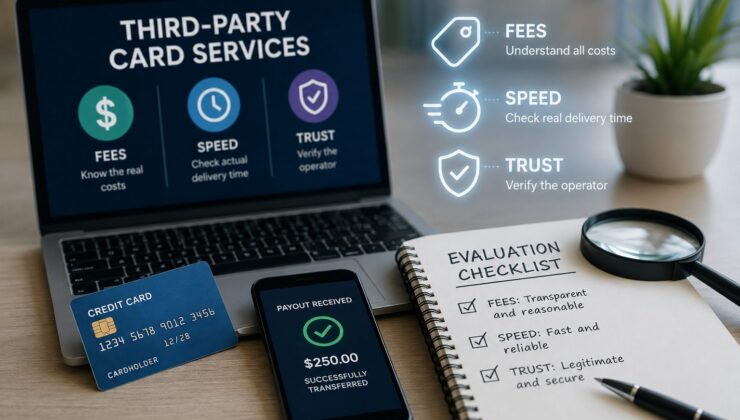
Somewhere between traditional banking and the app store's endless rows of finance icons sits a large gray zone of third-party card services — companies that are not your card issuer but that promise to do something useful with your card or the value attached to it. Balance conversion services, gift card exchanges, payment facilitators, cash-advance alternatives, bill-splitting intermediaries. Some are excellent, professionally run businesses filling genuine gaps that banks ignore. Others are fee traps with a nice logo. The difficulty for an ordinary consumer is that both kinds run the same ads and use the same soothing pastel branding. What separates careful users from unlucky ones is not intelligence; it is having a checklist. Here is one built around the three dimensions that matter most: what it costs, how fast it actually works, and whether the operator deserves your trust.
Fees: The Number They Show You and the Numbers They Don't
Every third-party card service earns money somewhere, and your first job is to find out exactly where. A headline fee — say, a flat percentage per transaction — is only the beginning. Look for the quieter charges layered underneath: payout fees for transferring money to your bank, "express" surcharges for the delivery speed the marketing already implied, inactivity fees, currency spread on anything cross-border, and minimum-transaction floors that make small conversions disproportionately expensive.
A useful exercise is to compute the effective rate on a realistic transaction of your own size, not the idealized large transaction the pricing page assumes. Services often look cheap at the top tier and expensive at the bottom. If a company will not let you see the full fee schedule before you register — if pricing lives behind a sign-up wall or, worse, is "quoted individually" — treat that opacity as a price in itself. Reputable operators publish their rates because their rates survive daylight.
This category of business exists worldwide under many names. In Korea, for instance, there is a whole search vocabulary around what Korean consumers call 카드깡업체 — third-party card-to-cash providers that convert card-accessible value into liquid funds — and the same fee-transparency test applies there as anywhere: the trustworthy end of the market states its percentage plainly, while the risky end buries it. Wherever you are shopping for such a service, the vendor who answers the fee question in one sentence is almost always safer than the one who answers it in a paragraph.
Speed: Promised, Typical, and Worst-Case
"Instant" is the most abused word in consumer finance. When a service advertises instant payouts, ask three separate questions. First, instant to where — an internal wallet balance, or your actual bank account? Money in a proprietary wallet is a promise, not a payout. Second, instant when — during business hours only, or nights and weekends too? Many services ride on banking rails that pause outside business days, and honest ones say so. Third, instant for whom — new users often face holding periods and manual review that established users skip.
The best evidence is not the marketing page but user reports of typical and worst-case timing. Scan recent reviews specifically for delay complaints and, more importantly, for how the company handled them. Every payment business has occasional slow transactions; the trust signal is whether support responded with a specific status or a canned apology. A service that communicates precisely during a delay is showing you its operational maturity. One that goes silent is showing you its future behavior when your money is the one in limbo.
Trust Signals: What a Legitimate Operator Looks Like
Trust is not a feeling; it is a stack of verifiable facts. Work through them in order. Does the company disclose a legal entity name and physical address, and do those check out in a business registry? Is there a real customer-service channel with a human on the other end — test it with a pre-sales question and time the response. Does the site use proper security basics, and does the privacy policy describe data handling in specific terms rather than boilerplate?
Then look at behavioral signals. Established services have a history: years of reviews with a normal distribution of praise and complaints, not a suspicious wall of five-star posts from accounts created last month. They set expectations conservatively and beat them, rather than promising perfection. They ask for the minimum information required to operate, not your entire digital identity on day one. And critically, they never pressure you. Countdown timers, "limited slots," and aggressive follow-up messages are conversion tactics that legitimate financial operators simply do not need.
One final habit protects you more than any other: start small. Whatever the service, run a minimal first transaction and watch the entire lifecycle — quote, execution, payout, statement record. That single low-stakes test will tell you more than an hour of reading marketing copy, because it converts every claim on the website into observed behavior.
Third-party card services are not going away; they exist because banks leave real needs unmet, from unlocking idle stored value to smoothing lumpy cash flow. Used carefully, the good ones are genuinely useful tools. The evaluation framework is stable even as brands come and go: total cost you can compute, delivery speed you can verify, and an operator whose identity, history, and conduct all point the same direction. When those three line up, proceed — modestly at first. When any one of them resists inspection, remember that in consumer finance, the absence of an answer is an answer.